Publications

Nuclear pasta and butterfly scales united by the same spatial microstructure

The gyroid is an ordered network-like labyrinth bounded by minimal surfaces. It has become a house-hold name in soft materials with order on the nanometer scale, for example in the nanoporous photonic crystals of some green butterflies.

Pasta_Gyroid_3D
The spontaneously formed Pasta Shape and the Gyroid have the same topology

B. Schuetrumpf, M. A. Klatt, K. Iida, G. E. Schröder-Turk, J. A. Maruhn, K. Mecke, and P.-G. Reinhard. Appearance of the Single Gyroid Network Phase in ‘Nuclear Pasta’ Matter. Phys. Rev. C, 91: 025801-1–7 (2015)


We here find by simulation that the same spatial gyroid structure forms spontaneously in nuclear matter at finite temperatures, as is prevalent in supernova explosions. While the structure of the gyroid in nuclear matter is the same as in soft materials, the length scale of a few femtometers is radically different, making this the discovery of the smallest reported gyroid found in dynamical simulations. The state of nuclear matter at this high nuclear density will greatly affect the neutrino transport during and after a supernova-explosion and is thus important to understand the production of heavy elements.

Link: https://journals.aps.org/prc/abstract/10.1103/PhysRevC.91.025801
Publications

Characterization of maximally random jammed sphere packings. I. Voronoi correlation functions

In this paper, we characterize the local and global structure of maximally random jammed sphere packings.

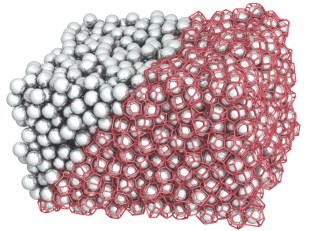
MRJ-sphere-packing-v3
MRJ sphere packing: (left) only the spheres, (right) spheres and Voronoi cells

M. A. Klatt and S. Torquato. Characterization of Maximally Random Jammed Sphere Packings: Voronoi Correlation Functions. Phys. Rev. E, 90:052120-1–12 (2014)

We characterize the structure of the maximally disordered packing among the set of all packings of monodisperse frictionless hard spheres, the so-called maximally random jammed (MRJ) sphere packing. Therefore, we compute the Minkowski functionals of the associated Voronoi cells and compare the structure to that of the Poisson point process (ideal gas) and of an equilibrium hard-sphere liquid.

In particular, we consider correlation functions or probability density functions of these Voronoi characteristics. Here we introduce and compute correlation functions and probability density functions of Minkowski functionals to quantify the global structure of the Voronoi diagram.

The local analysis using the distribution of the Voronoi volumes finds no qualitative difference for the structure of liquid or random jammed hard-sphere packings. In contrast to this, the higher-order statistical descriptors introduced here qualitatively distinguish the Voronoi structure of the MRJ sphere packings (prototypical glasses) from that of a hard-sphere liquid. We find strong anti-correlations in the MRJ sphere packings that arise because the MRJ state is “hyperuniform”.

Link: http://link.aps.org/doi/10.1103/PhysRevE.94.022152

Publications

Morphometric analysis in gamma-ray astronomy using Minkowski functionals. I. Source detection via structure quantification

In this paper, we introduce a morphometric data analysis of gamma-ray sky maps.

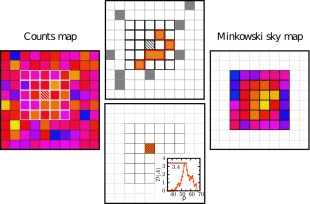
computation_Minkowski_sky_map
How to compute a Minkowski sky map

D. Göring, M. A. Klatt, C. Stegmann, and K. Mecke. Morphometric Analysis in Gamma-Ray Astronomy using Minkowski Functionals. Astron. Astrophys., 555:A38-1–7 (2013)

We introduce a novel approach to source detection via structural deviations from typical features of a random homogeneous background. Minkowski functionals are powerful tools from integral geometry; in 2D, they are the area, the perimeter and the Euler characteristics (a topological quantity, which is given by the sum of all components minus the sum of all holes).

Via a combination of these different geometric measures that quantify the shape of level sets of a counts map, more information can be taken out of the same data without the need to assume prior knowledge about potential sources.

We introduce Minkowski sky maps that quantify local structural deviations. Moreover, they localize and visualize potential sources.