Publications

Local number fluctuations in water

Using our recently developed platform for local number fluctuations with a special focus on the higher-order moments, we analyzed density fluctuations in ordered and disordered phases of water across temperatures.
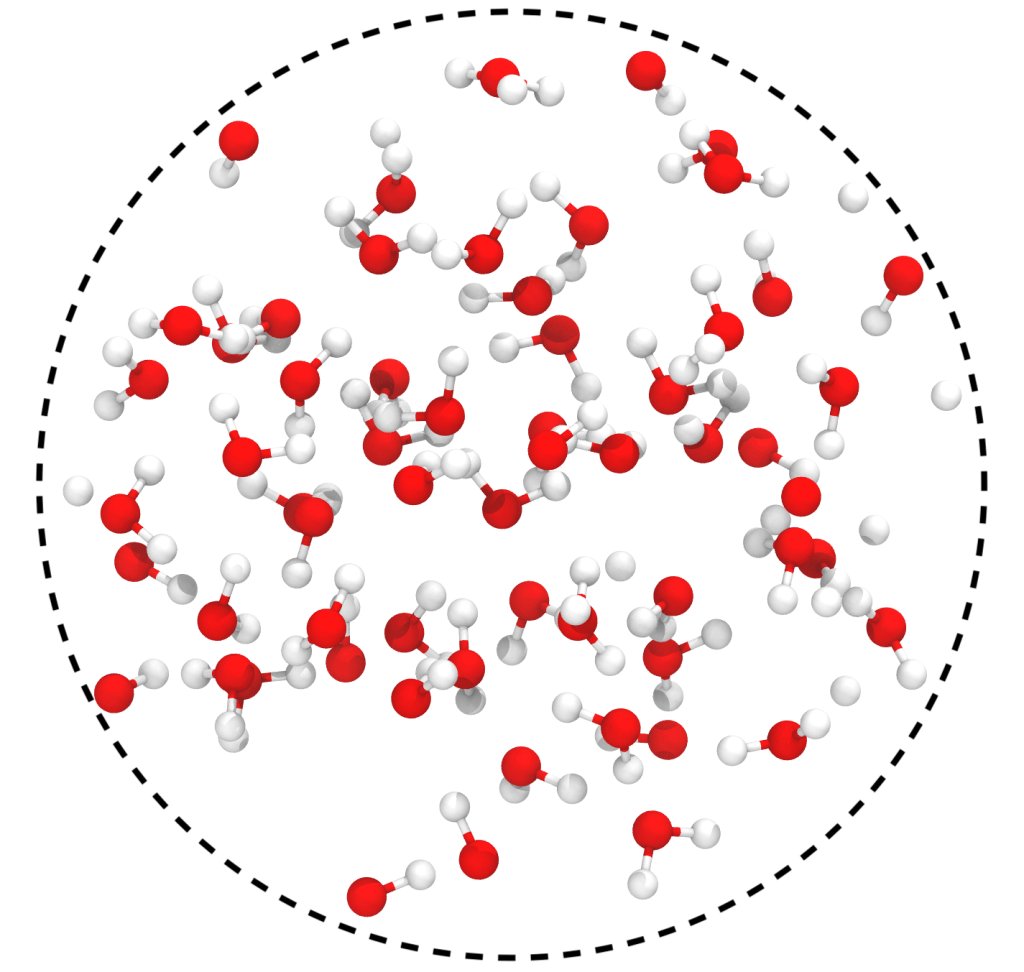
Michael A. Klatt, Jaeuk Kim, Thomas E. Gartner III, and Salvatore Torquato, Local number fluctuations in ordered and disordered phases of water across temperatures: Higher-order moments and degrees of tetrahedrality, The Journal of Chemical Physics 160, 204502 (2024).

Some anomalies of water are well-know, for example, that ice floats on
water because the crystalline ice is less dense than the disordered
liquid. These commonly known anomalies are only part of a large set
of interrelated anomalies of water in its dynamic, structural, and
thermodynamic properties.

In this work we find another anomaly in the density fluctuations of
water. Therefore, we use a recently developed platform to systematically
study local fluctuations in the number of molecules with a focus on the
higher-order moments of the distribution of these fluctuations. We apply
it to a rich variety of simulated states of water, crystalline and
disordered, in equilibrium and quenched, and for a broad range of
temperatures (from 80 K to 1600 K). What we find is yet another type of
anomaly: simply speaking, an approximation of the distribution by a
(standard) Gaussian distribution works best close to ambient conditions.
This local optimum around room temperature is probably due to a
balancing of thermal fluctuations and the tretrahedrality of water since
we observe clear signatures of tetrahedrality in the higher-order
moments. This new type of anomaly can help further studies to reveal new
links between the already known structural, dynamic, and thermodynamic
anomalies.
Publications

Goodness-of-fit tests for complete spatial randomness based on Minkowski functionals of binary images

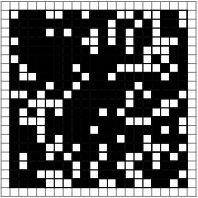
In this paper we use the Minkowski functionals for a rigorous null hypothesis test for complete spatial randomness.

excursion_set_binned_Poisson
Excursion set of a binned Poisson point process

B. Ebner, N. Henze, M. A. Klatt, K. Mecke. Goodness-of-fit tests for complete spatial randomness based on Minkowski functionals of binary images. Electron. J. Statist 12:2873–2904 (2018)

We propose a class of goodness-of-fit tests for complete spatial randomness (CSR). In contrast to standard tests, our procedure utilizes a transformation of the data to a binary image, which is then characterized by geometric functionals. Under a suitable limiting regime, we derive the asymptotic distribution of the test statistics under the null hypothesis and almost sure limits under certain alternatives. The new tests are computationally efficient, and simulations show that they are strong competitors to other tests of CSR. The tests are applied to a real data set in gamma-ray astronomy, and immediate extensions are presented to encourage further work.

Publications

Morphometric analysis in gamma-ray astronomy using Minkowski functionals. I. Source detection via structure quantification

In this paper, we introduce a morphometric data analysis of gamma-ray sky maps.

computation_Minkowski_sky_map
How to compute a Minkowski sky map

D. Göring, M. A. Klatt, C. Stegmann, and K. Mecke. Morphometric Analysis in Gamma-Ray Astronomy using Minkowski Functionals. Astron. Astrophys., 555:A38-1–7 (2013)

We introduce a novel approach to source detection via structural deviations from typical features of a random homogeneous background. Minkowski functionals are powerful tools from integral geometry; in 2D, they are the area, the perimeter and the Euler characteristics (a topological quantity, which is given by the sum of all components minus the sum of all holes).

Via a combination of these different geometric measures that quantify the shape of level sets of a counts map, more information can be taken out of the same data without the need to assume prior knowledge about potential sources.

We introduce Minkowski sky maps that quantify local structural deviations. Moreover, they localize and visualize potential sources.